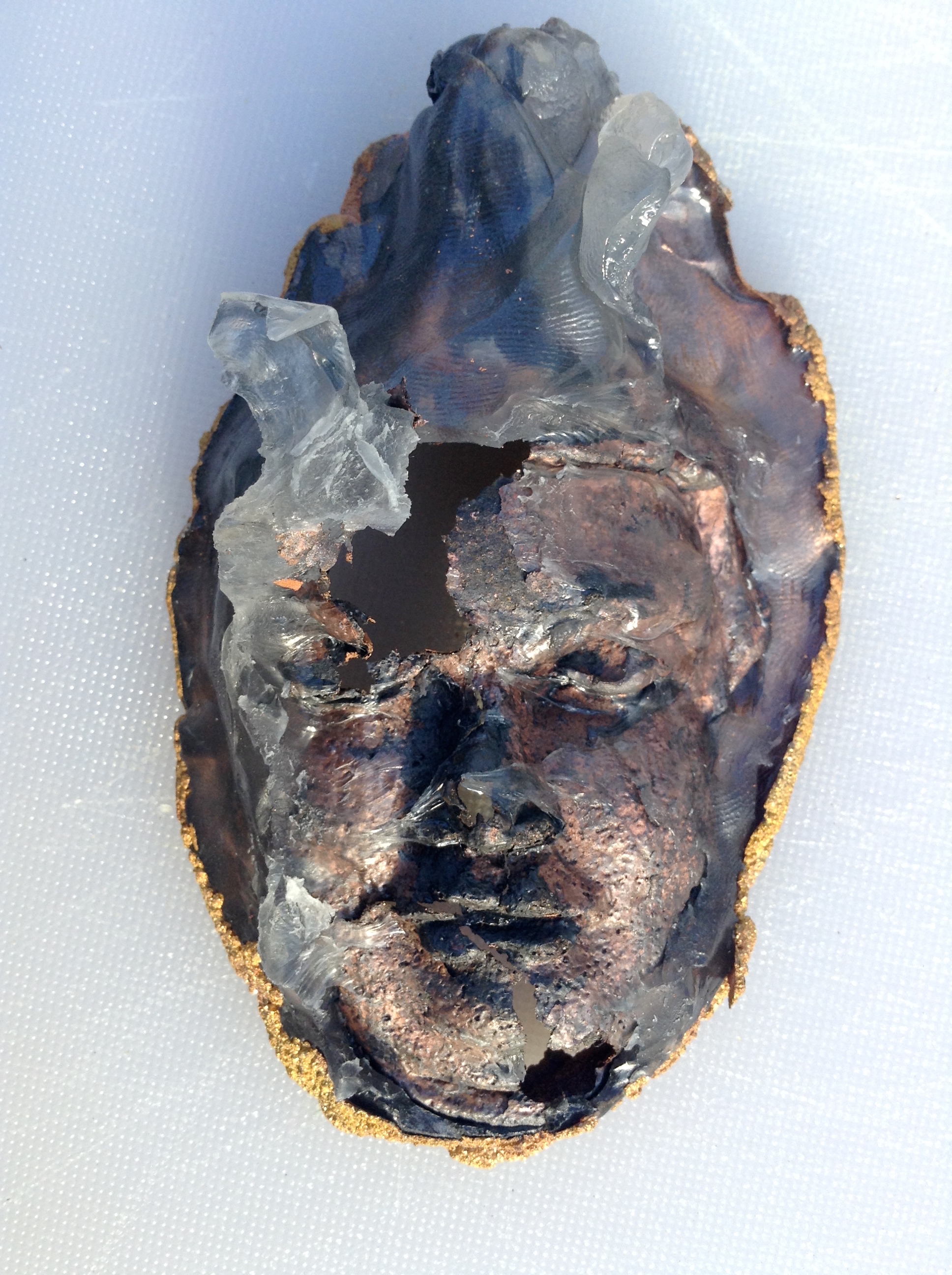


Unfortunately the mould stuck to the work.
Tag: etching
-
Demythologising electro- etch
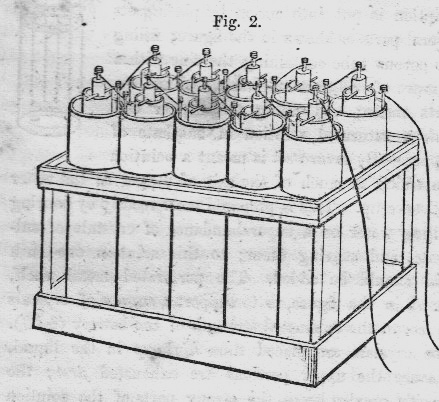
“If two plates of copper be connected with the opposite ends of a voltaic battery, in a vesessel containing very dilute sulphuric acid, the plate connected with the copper of the battery will be attacked by the anion oxygen which is released during the decomposition of the acid”.
“By alternately exposing the plates to the action of the decomposing fluid and stopping out parts of the work, the required gradation in tints is obtained.”

Battery 1850 “Electro-etching has the advantage of being free from the exhalation of any deleterious gas, but the apparatus required involving a battery and an extra copper plate, is more cumbrous, and the process itself more complicated, and does not appear to have been adopted for artistic work to any considerable extent.”
Chattock, R. S. (1883) Practical Notes on Etching. (2nd. edition) London: Sampson Low, Marston, Seale, & Rivington.
Although; the equipment we now have at our disposal is more effective, efficient and certainly can’t be described as cumbrous; the myth of complexity still sticks to electro-etching. Colin Gale and Megan Fishpool offer a key to demythologise the process in their excellent book ‘The Printmakers Bible’. They describe electro-etching as being “A reasonably complicated process and there are very few printmaking workshops with the equipment and ability to host it”. We are currently exploring the possibility of providing the equipment, training, and support fro electro-etching at The Regional Print Centre in Wrexham. If we can make this happen, it will help other artists to explore the mark making potential of electro-etch.
-
Electrotype Manipulation 1852
Describing electro-etching in 1852 “If, for instance, plates of copper be covered on any part of their surface with a stratum of varnish, that part will be excluded from the line of action, while all else is being consumed. Advantage has been taken of this, by coating the plate with proper composition and then tracing through it any design, of which an etching is required. The plate in this condition is submitted to the action of nascent oxygen, and the surface is readily and effectively etched. There is some superiority to possessed by this method, over the ordinary etching by the use of nitric acid; for the operation can be conducted with considerable regularity; it can be rendered a slow or speedy process; and the results can be taken out from time to time, to be examined, and can be re-submitted in a moment.”

Face plate 1852 -
Proposal For Research Into Electro-Etch
Rationale For Proposed Research
Intaglio Etching remains popular today with artists who enjoy the creativity of its line, tonal range and gravitas of expression. Though its roots are in the fifteenth century it has adapted to modern mark making techniques such as photography and digital media, Smith, A. (2004 p.9). Many of the great artist have of the past and present have made intaglio prints as a significant part of their output – to name a few; Goya, Hogarth, Blake, Picasso, Chagall, Motherwell, Hockney, Oldenburg, Hodgkin.
For the last one hundred and fifty years nitric acid has been used as a mordant to bite etching plates. Today the traditional acid based printmaking studio is considered to be a hazardous work environment. The fumes from nitric acid are toxic, impacting on both individual health and environmental safety. The toxic nature of the chemicals, solvents and acids used in traditional printmaking require fume cupboards and specialist ventilation equipment that is beyond the reach of most artists.
Since the early 1990s a growing awareness of the potential health and environmental hazards of traditional etching techniques has led to a real interest in exploring safer and less toxic methods of etching and printmaking (Adam, R and Robertson C. 2007). Another response has been that a number of colleges and art schools have taken etching out of their curricula. (Keith Howard 1993 p. 20) suggests that the lack of exposure to etching as an art form during secondary education and the potential health and environmental hazards of traditional etching will alienate potential students from the art form. He argues that the vitality of etching depends on young people being offered the opportunity to learn about and practice the art.
Summary
The teaching of etching in educational institutions is in decline due to:
- The increasing cost of materials,
- The cost of adapting the environment due to changing health and safety legislation,
- The lack of an effective alternative to acid etching.
Research work and tasks carried out
The researcher is a member of the Regional Print Centre in Wrexham and has a close working relationship with the Leinster Print Centre in the Republic of Ireland. The initial research question came from conversations with members and staff of the two centres while he was researching the saline sulphate as a safe mordant of as part of his M.A. research.
“Are there etching techniques that can be used safely by artist’s in their homes, studios and places of education?”
There were three strands to the research process,
- Action Research: To form a reflective framework to bring together and examine the data and results of the scientific enquiry and practice as research.
- Scientific Experimental Enquiry: to identify and test techniques that can be used in artist’s home studios and places of education.
- Practice as Research: making artwork to explore the mark making potential of the methods identified by the experimental enquiry.
Same Metal Electro-Etching
Through the literature search a process known as electro-etch was identified as being the best replacement for acid as a mordant. Although electro-etching has been known about since the early days of research into electricity and electric cells (batteries) its use, as an artistic tool has been little exploited.
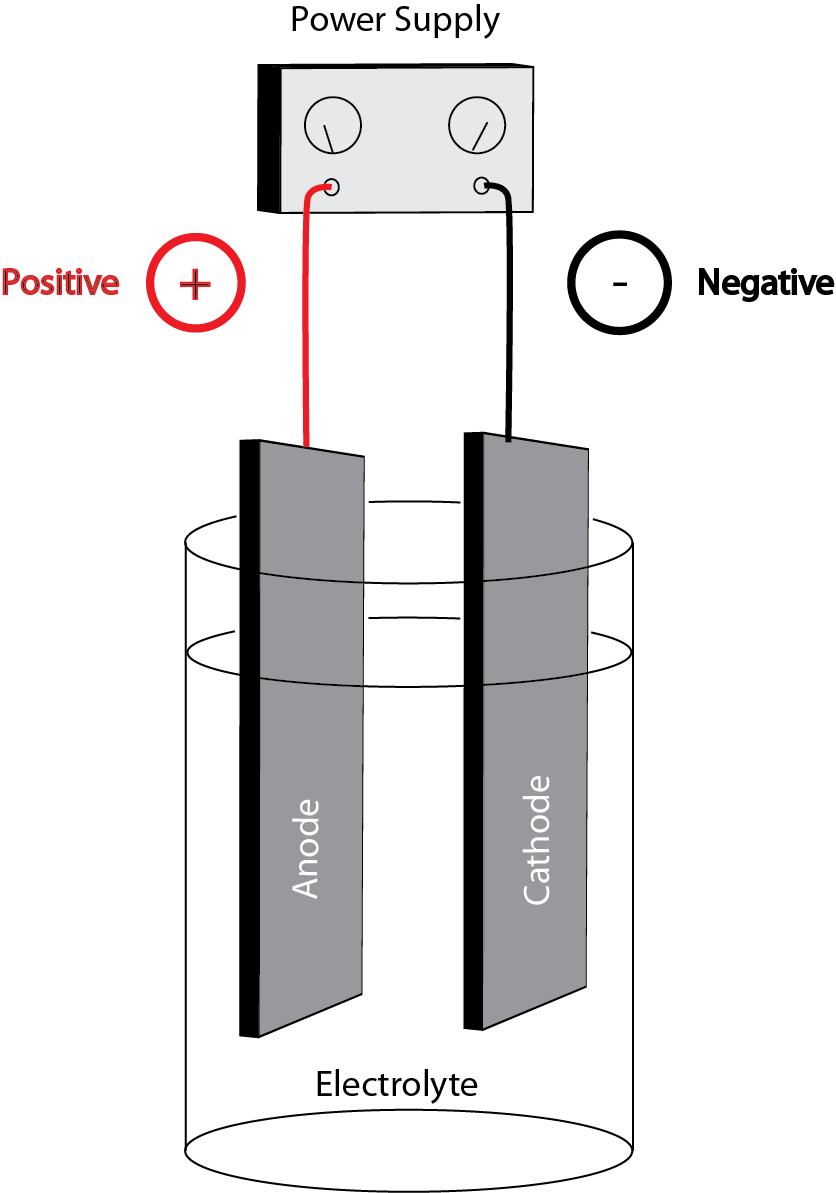
Electro-etching is based on electrolysis and provides a simple, safe and inexpensive way of etching metal. It can be used on copper, zinc, iron/mild steel. It can also etch aluminium that is significantly cheaper than the traditional metals used for etching. Electro-etching requires two metal plates – the one to be etched and another plate called the cathode; a battery and a plastic container holding a liquid, an “electrolyte”.
 The plates are placed in the electrolyte and each plate is connected to one of the terminals of the battery. An electric current flows from one plate to the other through the electrolyte and metal is corroded or etched from the plate. In same metal etching the anode and the cathode are of the same metal and the electrolyte is made up from the salt of that metal i.e. when etching copper both electrodes are copper and the electrolyte will be copper sulphate, when etching zinc the electrodes are zinc and the electrolyte is zinc sulphate.
When comparing same metal electro-etching to acid etch in 1883 Richard S. Chattock noted, “Electro-etching has the advantage of being free from the exhalation of any deleterious gas.”
The advantages for same metal electrolysis have been identified as
- No toxic gasses are produced; this eliminates the need for expensive ventilation systems.
- The system is self-sustaining so the electrolyte only requires topping up because of evaporation.
- The stability of the system means that biting times can estimate accurately unlike acid, ferric chloride, saline sulphate or Bordeaux etch which tire over time requiring etch times to be adjusted for an ever weakening mordant.
- Produces a better-drawn line than other mordants.
The problems that relate to the disposal of toxic chemicals are almost eliminated, because as long as the electrolyte is filtered occasionally, it will have an infinite life, Semenoff (1998).
Taking Keith Howards (1993) point that the vitality of etching is reliant on giving young people the opportunity to learn the art. From the literature and the research carried out so far it is clear that same metal and same metal salt etching is safe, effective, economical and can be used in a classroom situation.
Research Plan for next year
These objectives are based on the researchers learning from the previous research and were identified in a critical review of literature and research so far.
The overall aim is to explore and further develop the potential of electro-etching and electrolysis as an artistic medium.
The project objectives:
Build a community of practice:
- It is envisaged that the centre will develop into a community of practice for electro-etching with members sharing information, experiences and learning together.
- Easy to access electro-etching units, along with workshops for members, technical support and studio time at the Regional Print Centre in Wrexham should facilitate this.
- This provision has the potential to provide a showcase and focus for the development of electro-etching in the U.K.
Collect analyse, interpret into lay language the currently dispersed literature on electro-etching and electrotype:
- As identified in the literature review there is a need to gather together the dispersed scientific and technical information on electrolysis and put it into a form and language that will make it understandable and useful for artists. There is a clear need to demystify the electrolytic process and make it accessible. The purpose is to provide a comprehensive source of information for electro-etching.
Continue research into the electro etching of aluminium:
Produce a portfolio of work that explores the unique mark making potential of electro-etch, focusing particularly on the etching of aluminium.
- The researcher intends to develop a portfolio of work over the next twelve months that explores the techniques and the mark making potential of electro-etching and electrotyping.
Continue research into the art, practice and science of electro etching and electrotyping.
Bibliography
Chattock,R.S. (1883) Practical Notes On Etching, 2nd. Ed, London: Sampson, Low, Marston, Searle & Rivington.
Howard, Keith. (1993). ‘Safe Etching and Photo Etching: The next generation’. Print Making Today, Vol. 2 No 3. pp. 19-21
Semenoff, N and Christos, C. (1991) Using Dry Copier Toners and Electro-Etching on Intaglio Plates Leonardo, Vol. 24, No. 4 (1991), pp. 389-394.
Smith, A. (2004) Etching: a guide to traditional etching techniques, Ramsbury, Marlborough Wiltshire: The Crowood Press.


